




Green Hydrogen in Brazil: Why Here, and How to Design a Plant, From Site Selection to Stack Health








Speaker:
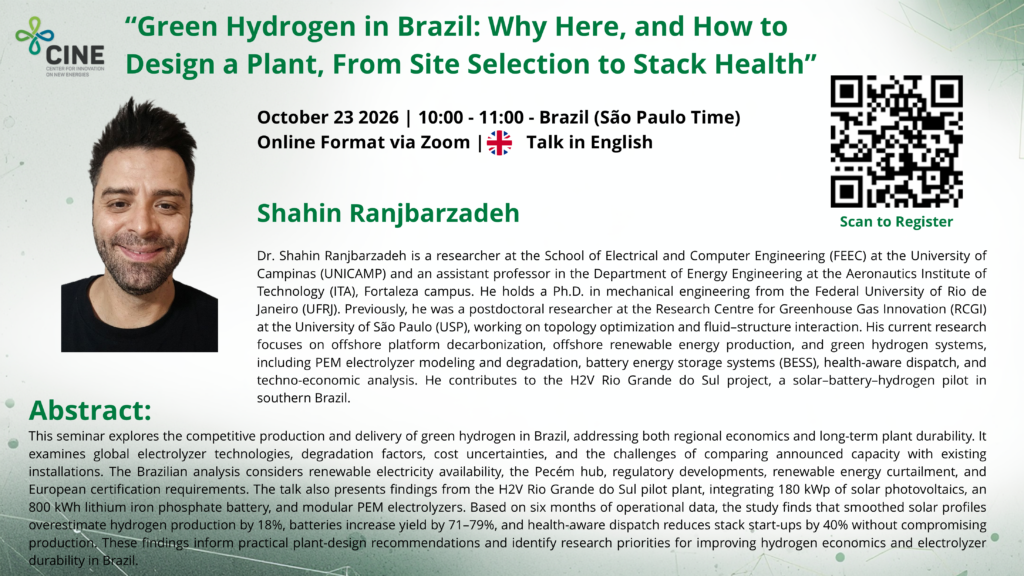
Dr. Shahin Ranjbarzadeh is a researcher at the School of Electrical and Computer Engineering (FEEC) at the University of Campinas (UNICAMP) and an assistant professor in the Department of Energy Engineering at the Aeronautics Institute of Technology (ITA), Fortaleza campus. He holds a Ph.D. in Mechanical Engineering from the Federal University of Rio de Janeiro (UFRJ). Previously, he was a postdoctoral researcher at the Research Centre for Greenhouse Gas Innovation (RCGI) at the University of São Paulo (USP), working on topology optimization and fluid–structure interaction. His current research focuses on offshore platform decarbonization, offshore renewable energy production, and green hydrogen systems, including PEM electrolyzer modeling and degradation, battery energy storage systems (BESS), health-aware dispatch, and techno-economic analysis. He contributes to the H2V Rio Grande do Sul project, a solar–battery–hydrogen pilot in southern Brazil.
Abstract:
Where can green hydrogen be produced and delivered competitively, and how should a plant be designed so that it lasts? This seminar addresses both questions in the context of Brazil.
The talk begins from a global perspective: electrolyzer technologies differ widely in stack lifetime, while operational heat and intermittent power can significantly accelerate degradation. Busbar electricity cost proves to be an incomplete guide to delivered cost once capital expenses, capacity factor, water supply, and offtake logistics are integrated. A narrative review across seven world regions highlights why reported costs cannot yet be reliably ranked, contrasting the ~2 GW of currently installed global capacity with the ~520 GW announced for 2030. Brazil is then examined in depth, considering its 88.2% renewable grid, the Pecém hub, the new federal regulatory decree, wind and solar curtailment patterns, European origin rules, and an illustrative index for hub comparisons.
The second half focuses on plant design, drawing empirical insights from the H2V Rio Grande do Sul project—a solar–battery–hydrogen pilot plant in southern Brazil featuring 180 kWp of PV, an 800 kWh LFP battery, and a modular 4 × 15 kW PEM electrolyzer system analyzed using six months of measured 5-minute PV operational data from 2026. Five design steps yield four central findings:
1. Smoothed solar profiles overestimate hydrogen yield by 18% and miss over half of stack start-up cycles.
2. Under oversized PV conditions, the power-splitting strategy among stacks affects overall output by less than 0.5%, yet alters start-ups by 27%.
3. Adding a battery increases yield by 71–79%, though it shifts electrochemical stress rather than eliminating it.
4. Health-aware dispatch strategies reduce stack start-ups by 40% at equivalent production levels.
The seminar concludes with an actionable design checklist for Brazilian plants and identifies critical research pathways needed to bridge renewable siting with long-term stack durability.
Link for registration: https://docs.google.com/forms/d/e/1FAIpQLSf-76vSixnuC48vDZGlw7vdpxMV32NCig6nRad5KtWAQBLufA/viewform
Green Hydrogen in Brazil: Why Here, and How to Design a Plant, From Site Selection to Stack Health
English
Dr. Shahin Ranjbarzadeh
