




Interview with Jilian de Freitas, Co-PI of the Energy Generation division








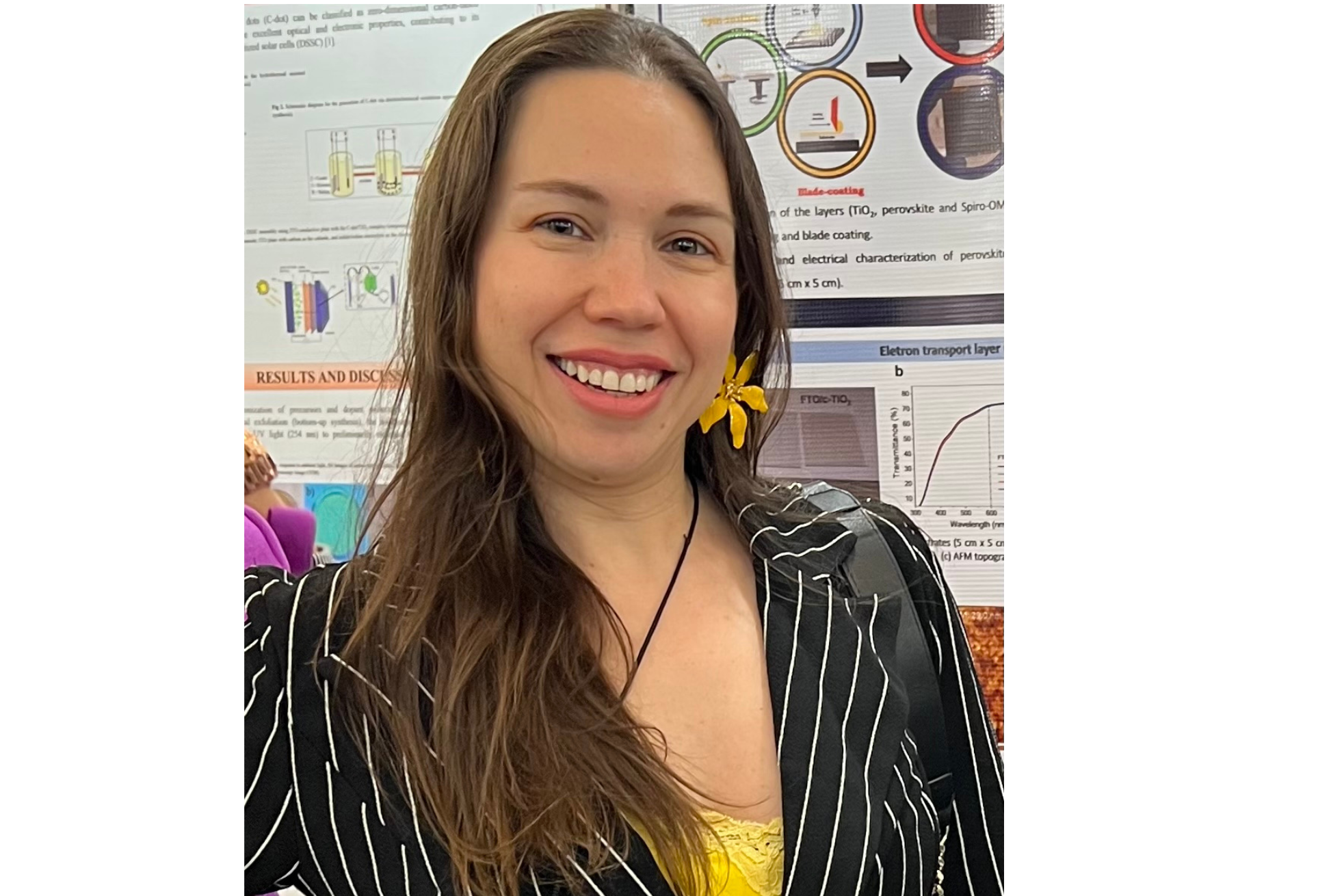
Jilian Nei de Freitas was still an undergraduate student at UNICAMP when she made decisions that shaped her professional trajectory.
At that time—the year 2000—seeking to fulfill her childhood dream of becoming a scientist and building the future, she decided to embark on undergraduate research in a cutting-edge field where the results could be applied to actual products. Consequently, she started working on the development of emerging solar cell technologies.
After completing her undergraduate degree in Chemistry at UNICAMP in 2002, Jilian continued doing research in emerging solar cells during both her master’s degree in Inorganic Chemistry (completed at UNICAMP in 2005) and her PhD in Science (also at UNICAMP), which included a research stint at the Linz Institute for Organic Solar Cells in Austria.
Between 2010 and 2011, she conducted a postdoctoral project at UNICAMP’s Nanotechnology and Solar Energy Laboratory. During this period, she traveled abroad again for short-term research stays at the University of the Witwatersrand (South Africa), Wayne State University (USA), and Imperial College (UK). After her postdoc, she decided to gain experience in the private sector, thus working as a researcher for a startup and for a multinational company.
In 2013, the scientist joined the Center for Information Technology Renato Archer (CTI) in Campinas, São Paulo, where she continues to conduct research as a senior technologist.
A researcher at CINE since 2018, Jilian has coordinated the solar energy arm of the Energy Generation division since 2025. Within the program, she also leads projects dedicated to developing manufacturing routes for perovskite solar cells that are of interest to the Brazilian industry.
Furthermore, alongside her scientific career, Jilian has always dedicated herself to nurturing her artistic side through courses and performances in music and dance.
Read our interview with this CINE researcher to learn more about her work and her perspective on academia, the industrial sector, and the arts.
What motivated you to pursue an undergraduate degree in Chemistry and a career as a researcher? Were you inspired by other women scientists?
I grew up with a father who loved reading science fiction and a mother who worked as a researcher in the field of Education. As a child, I was playfully captivated by the idea of becoming a scientist and working on futuristic projects. When the time came for university entrance exams, I chose Chemistry because it was the science subject I found easiest in school. Early in my second year of the Chemistry program at UNICAMP—in January 2000—I decided to get involved in scientific research by starting an undergraduate research project. I wanted to work in a cutting-edge technological field, combining state-of-the-art science with concepts applicable to industrial products. That was when I was introduced to Professor Marco-Aurélio De Paoli, who was working with the famous “conductive polymers” (which won the Nobel Prize in Chemistry in 2000!) across a range of technological applications, such as electrochromic windows, organic transistors, and solar cells. Among the research lines Professor De Paoli presented during our initial conversation, I was drawn to photovoltaics and emerging solar cells—specifically TiO2/dye-sensitized cells (also known as Grätzel cells), which were a hot topic at the time. It was in this context that I met Ana Flávia Nogueira and Claudia Longo—now Professors at the UNICAMP Institute of Chemistry (IQ-UNICAMP) and members of CINE—who, at the time, were pursuing their PhD and postdoctoral studies, respectively, in Professor De Paoli’s group. Both served as co-advisors for my undergraduate research project, and I owe much of what I learned about solar cells—as well as the world of research, scientific methodology, and scientific writing—to them. However, perhaps even more important than those aspects was witnessing firsthand the passion with which both researchers pursued their scientific projects. It was a privilege to see the early stages of their careers; they have certainly been my primary professional inspirations.
You have experience as a researcher in both academia and the corporate world—two possible paths for students in the exact sciences and technology fields. Could you discuss the specific characteristics of these two professional experiences?
At the end of my second year of postdoctoral research, in early 2012, I decided to diversify my experience and work in the private sector. I initially joined the team at the startup Tezca—founded by Dr. Agnaldo de Souza Gonçalves and incubated at Ciatec in Campinas—to work on developing flexible solar cells on metal substrates. At that time, initiatives related to scientific entrepreneurship and the creation of “deep tech” startups did not receive the same level of support and encouragement from funding agencies that they do today. Furthermore, Brazil was just beginning to regulate its photovoltaic sector, and there was little financial incentive for this type of energy back then. During my time at Tezca, I witnessed the countless challenges faced by those trying to pioneer a sector that was still in its infancy. That reality differs from the current one in several ways. For instance, the funding provided by FAPESP for PIPE programs is much higher today, and the photovoltaic power generation market in Brazil has grown significantly and continues to expand. There is now a clearer understanding among various societal stakeholders regarding the need to invest in renewable energy, drive the energy transition, and pursue technological independence—efforts that include supporting deep tech companies. After my time at Tezca, I had the opportunity to work at DuPont in Paulínia (São Paulo state), developing a new type of product for the agricultural sector. It was an interesting period during which I could observe the different work dynamics within a large corporation. I noticed that the work was more focused, with less leeway to change course mid-project, and the emphasis was heavily placed on product development. During that time, I gained insights that I still carry with me in my career today—lessons addressing areas that might be lacking in a purely academic background: making decisions based on cost assessment, focusing on actions that yield practical results, and recognizing the importance of partnerships and networking. On one hand, academia offers far greater creative freedom, which fosters the development of disruptive solutions. On the other, the productive sector is driven by a pragmatism that—while it may limit creativity—enables ideas to be transformed into practical realities. In academia, scientists can exercise their creativity much more freely; however, precisely because of this, knowledge can sometimes become diffuse and fail to translate into practical solutions. This highlights the importance of combining both worlds if we want to generate and successfully implement truly innovative solutions.
You dance and write song lyrics… Tell us a little about your artistic side.
I started dancing as a child. During my teenage years, I took classes in classical ballet, modern dance, jazz, piano, and keyboard. I have always loved music and dance, and if I could, I would devote even more time to them. Art has always been part of my life—even in the form of martial arts (I hold a red-tip belt in Taekwondo). While training to become a scientist, I took various dance courses: ballroom, Gypsy dance, hip-hop, flamenco, and belly dance. I also attended two music composition workshops with singer-songwriter Leoni (yes, the one who wrote the song “Garotos”!). I used to view these activities as an escape from the scientific side to the artistic side—a sort of outlet. It was as if one were the serious side and the other the fun side. However, over the years, as I gained more experience in both science and the arts, I realized they are very similar. In both fields, we use our creative expression, taking the foundation we absorb from the outside world and combining it with our own insights. They simply translate into different results, but I would say their essence is quite similar. Furthermore, having associated with successful professionals who make a living from music or dance, I’ve noticed another commonality between the arts and sciences: creativity is essential to both, yet without discipline and tenacity, one doesn’t reach interesting places.
You are the deputy coordinator of CINE’s Energy Generation division. Could you discuss its major objectives and main challenges in the solar energy arm?
At CINE—specifically within the solar energy arm of the Energy Generation division—the main challenges we are addressing can be summarized across three axes:
– Understanding the phenomena responsible for degradation in perovskite cells, aiming to extend their lifespan.
– Developing materials and processes to fabricate larger-area cells, or mini-modules, using domestic technology.
– Increasing the cells’ energy conversion efficiency.
Regarding the first axis, I would highlight the research conducted by Professor Ana Flávia Nogueira’s group. Utilizing synchrotron light techniques at Sirius and in situ experiments, their work has gained international recognition for significantly advancing the understanding of the mechanisms that reduce the stability of perovskite technology.
As for the second axis, we are investing in transforming knowledge into products. In this instance, we aim to demonstrate the feasibility of producing perovskite solar cells using domestic inputs and low-cost, scalable processes. We are seeking manufacturing routes that appeal to the domestic industry by offering low CAPEX and OPEX.
Regarding the third axis, among the approaches used to boost energy generation, I highlight photon management—specifically the use of up-conversion or down-conversion materials and quantum dots. These methods tune how the perovskite absorbs light, thereby increasing the number of electrons generated by the device. Another notable approach is the use of thermal evaporation to deposit the perovskite layer; this technique facilitates the formation of films with fewer defects at grain boundaries and interfaces, leading to greater device reproducibility and higher electric current generation.
I believe the research conducted at CINE offers real opportunities to build Brazilian capabilities in key technological areas—vital for both the energy transition and national sovereignty—including the potential to customize solutions that better meet domestic needs.
