




Computational Insights into Iridium-Based Electrocatalysts for Water Splitting








Abstract
Computational insights into iridium-based electrocatalysts for water splitting are presented using density functional theory and the computational hydrogen electrode model. Metallic Ir and its oxides (IrO₂ and Ir₂O₃) were analyzed across different surfaces. IrO₂ surfaces show optimal energetics for the oxygen evolution reaction, especially the (100) facet with low overpotential. Metallic Ir and α-Ir₂O₃ (0001) are promising for hydrogen evolution. Results highlight how surface structure and electronic properties govern catalytic performance.
Speaker
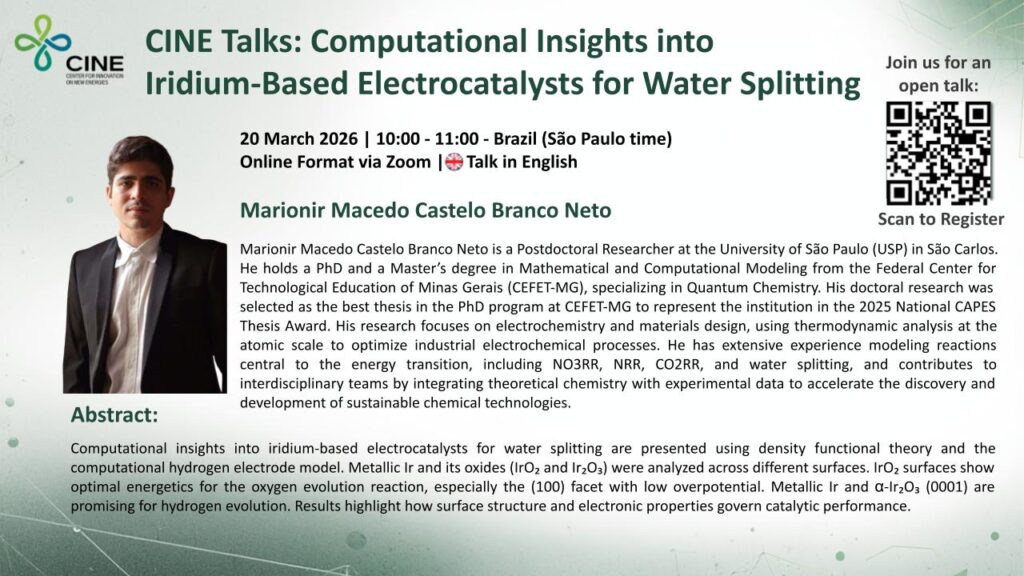
Marionir Macedo Castelo Branco Neto is a Postdoctoral Researcher at the University of São Paulo (USP) in São Carlos. He holds a PhD and a Master’s degree in Mathematical and Computational Modeling from the Federal Center for Technological Education of Minas Gerais (CEFET-MG), specializing in Quantum Chemistry. His doctoral research was selected as the best thesis in the PhD program at CEFET-MG to represent the institution in the 2025 National CAPES Thesis Award. His research focuses on electrochemistry and materials design, using thermodynamic analysis at the atomic scale to optimize industrial electrochemical processes. He has extensive experience modeling reactions central to the energy transition, including NO3RR, NRR, CO2RR, and water splitting, and contributes to interdisciplinary teams by integrating theoretical chemistry with experimental data to accelerate the discovery and development of sustainable chemical technologies.
Link to registration: https://docs.google.com/forms/d/e/1FAIpQLSf-76vSixnuC48vDZGlw7vdpxMV32NCig6nRad5KtWAQBLufA/viewform
Computational Insights into Iridium-Based Electrocatalysts for Water Splitting
English
Dr. Marionir Macedo Castelo Branco Neto
