




CINE research optimizes the crystallization of 2D/3D perovskites








 E-mail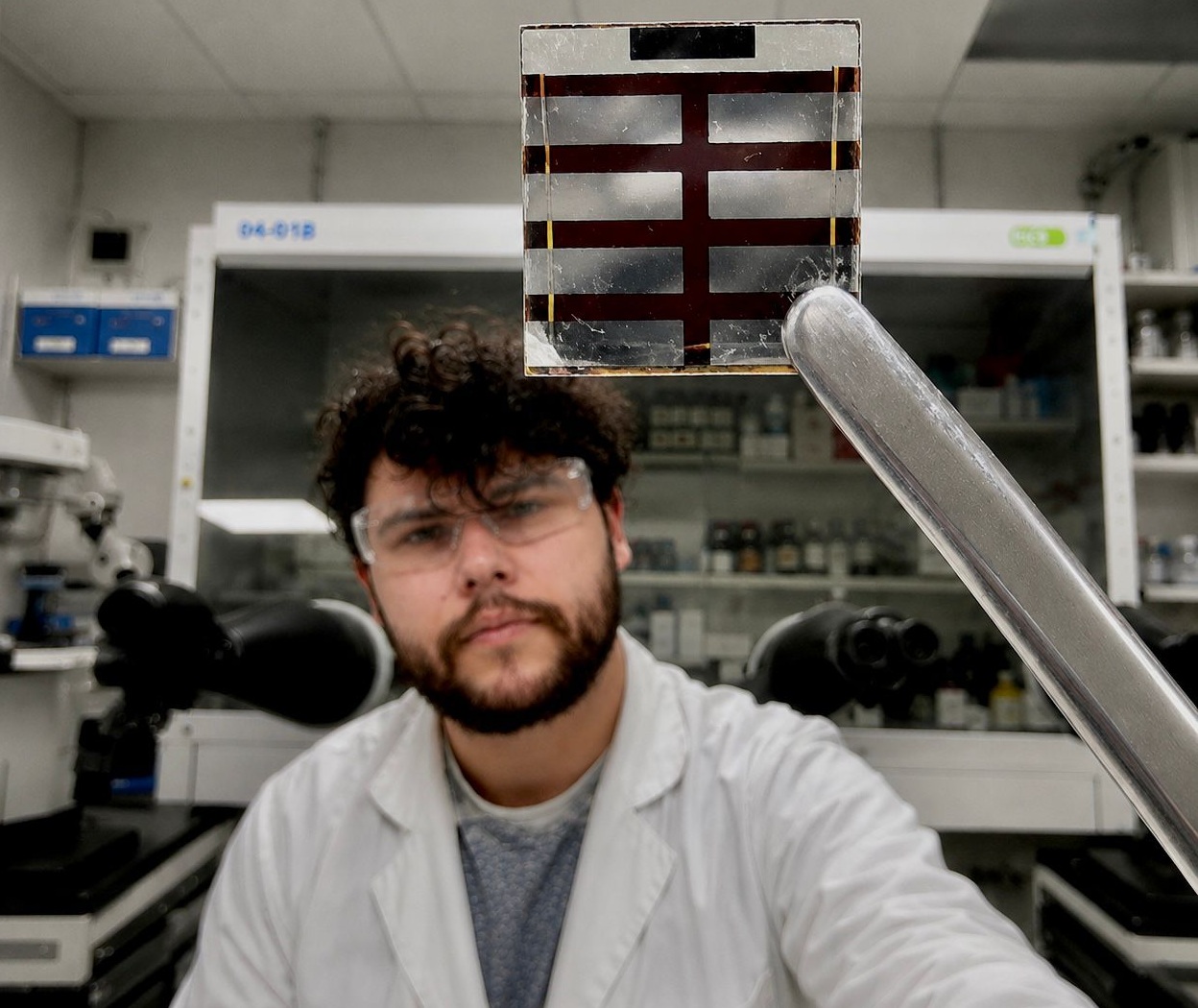
In a study entirely conducted in Brazil, a team of scientists developed an innovative strategy to optimize the performance and durability of perovskite solar cells. The proposal involves using molecules with large carbon chains to control the crystallization of perovskite films in more than one dimension.
Metal halide perovskites are already considered the best option for the next generation of solar cells. That is why they have received considerable attention from the scientific community aimed at optimizing their properties. In this sense, a promising approach is that of 2D/3D perovskites. These films combine regions with a three-dimensional structure, similar to a network of interconnected cubes, and regions with a two-dimensional structure, similar to a flat sheet. The combination allows for the best properties of both structures: the durability of the two-dimensional perovskite and the efficiency of the three-dimensional one.
“2D perovskites are very interesting because they are much more resistant to degradation; this is already a fact,” says Professor Ana Flávia Nogueira (UNICAMP), researcher and director of CINE. “Therefore, it is possible that future commercial perovskite solar cells will contain some type of 2D structure,” comments the scientist, who is an international reference in perovskite solar cell research.
To produce perovskite films, a solution with various chemical compounds is prepared. During crystallization, the solvent evaporates and the other substances organize themselves into a solid and ordered structure. The process happens spontaneously, but regulating it is extremely important to optimize the properties of the films.
In this work, the authors studied in detail an ingredient of the solution, a long-chain organic cation, which is the additive responsible for regulating the formation of two-dimensional regions in 2D/3D perovskite films. The focus of the study was to understand whether the size of the molecule would impact the performance of the material in solar cells.
“This work presents an innovation of attempting to control the formation of these 2D perovskite structures in a different way by introducing organic cations with different chain lengths into the precursor solution,” says Ana Flávia, corresponding author of the article reporting the study, published in the high-impact journal ACS Energy Letters.
The results showed that intermediate-length cations optimized crystallization, preventing the formation of defects and generating a more organized and uniform structure. Consequently, the solar cells based on films modified with these molecules achieved the highest efficiency rates in converting light into electricity.
The research was conducted in laboratories at UNICAMP and CNPEM and received funding from Fapesp, Shell, and CNPq, in addition to strategic support from ANP.
Paper reference: Murillo Henrique de Matos Rodrigues, Josiane A. Sobrinho, Arthur Pignataro Machado, Zeno C. Brandao, Ingrid D. Barcelos, Cilene Labre, Rodrigo Szostak, Ana Flávia Nogueira. Tuning Structure and Performance of 2D/3D Perovskites by Alkyl Chain Length Engineering. ACS Energy Lett. 2026, 11, 2, 1631–1641. https://pubs.acs.org/doi/10.1021/acsenergylett.5c02838
CINE members and former members who participated in the work: Murillo Henrique de Matos Rodrigues (postdoctoral researcher), Josiane A. Sobrinho (former member), Arthur Pignataro Machado (doctoral student), Zeno C. Brandao (master’s student), Rodrigo Szostak (former member), and Ana Flávia Nogueira (researcher).
Contact

Ana Flávia Nogueira
UNICAMP
