




CINE study shows a path to optimizing sodium supercapacitors








 E-mail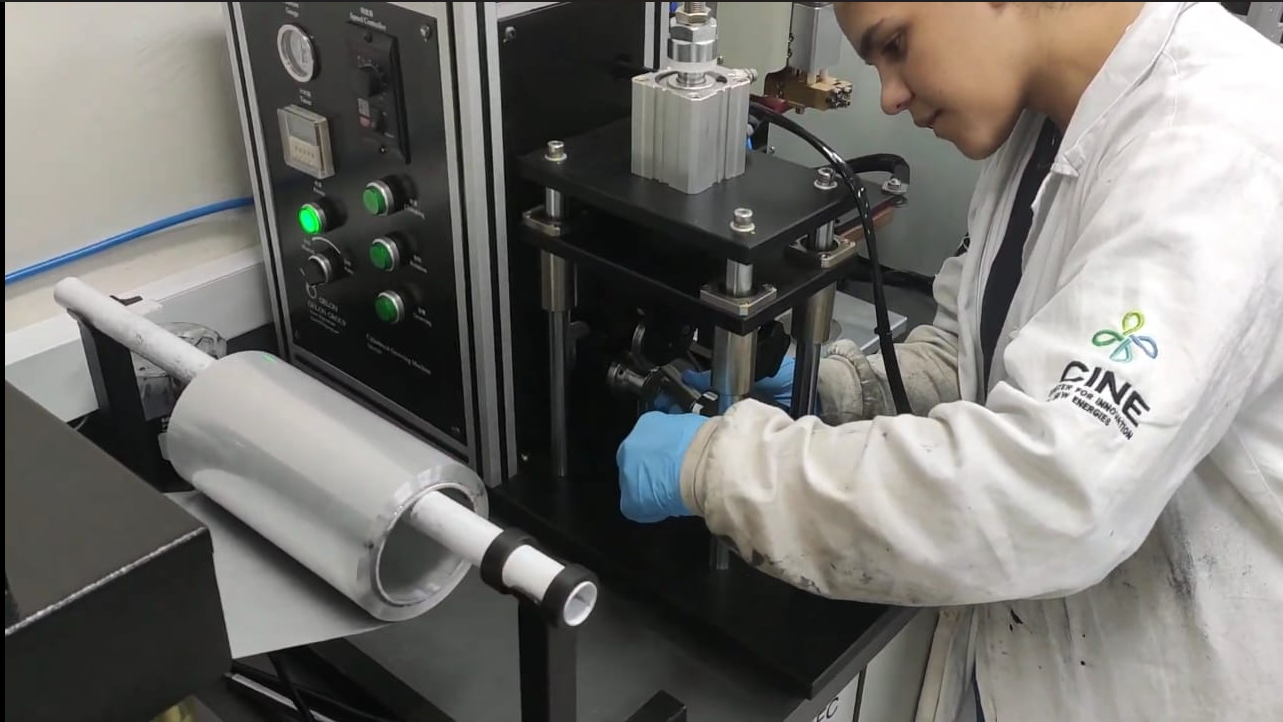
A research work conducted at CINE contributes to the development of more efficient, safe, and durable sodium supercapacitors. The results may help shorten the path to commercialization of these promising energy storage devices.
Currently, commercial supercapacitors use lithium ions in their electrolytes, but interest in using sodium ions has been increasing. In fact, this element, which can offer similar performance to lithium, is more abundant and better distributed across the planet, making the devices more sustainable and economically viable, especially for large-scale applications.
Supercapacitors stand out among energy storage devices for their power, which is the speed at which they can charge and deliver energy. Because of this characteristic, they are used in electrified vehicles within systems such as regenerative braking, which transforms the kinetic energy of deceleration into electricity, and start-stop systems, which automatically shut off and restart the engine during brief stops. Furthermore, they can be used in electrical grids to stabilize fluctuations generated by the intermittency of solar and wind energy. However, supercapacitors have limitations regarding their energy density, which is the amount of electricity that can be stored in a given weight or volume.
In this work, the authors demonstrate that it is possible to precisely adjust the properties of the supercapacitor through the careful selection of the compound used in the electrolyte to dissolve sodium ions. “In our study, by using mixtures of different solvents, we were able to significantly increase the energy density of the supercapacitors,” says Raissa Venâncio, who developed the research as part of her doctoral studies at UNICAMP, within the context of CINE.
The study also involved other researchers from UNICAMP and scientists from Mackenzie, the Federal University of the Jequitinhonha and Mucuri Valleys, Eldorado Institute, Nova University of Lisbon (Portugal), and the CARISSMA Institute for Electric, Connected and Safe Mobility (Germany).
During the research, the authors produced four types of solvents commonly used in research in sodium-based electrolytes and assembled small supercapacitors with each of them. The performance of the devices was studied using an innovative approach that combined classical electrochemical characterization techniques with “operando” electrochemical mass spectrometry.
In this way, the team was able to characterize the supercapacitors while they were operating, during charging and discharging. “We measured how much energy they store, how fast they charge and discharge, and how their performance changes over time,” says Raissa. At the same time, the authors monitored in real time the formation of gases inside the device – a relatively common phenomenon in batteries and supercapacitors. “Knowing which gases appear, when, and in what quantity is important because they indicate wear, can reduce lifespan, and even represent safety risks,” explains the researcher.
This approach allowed them not only to verify the performance of the supercapacitors but also to understand the reason for failures. “This helped us understand how each electrolyte impacts performance, stability, and lifespan, allowing us to guide the development of more efficient, safe, and durable devices—three essential factors for commercialization,” says Raissa.
According to the researcher, the electrolytes studied, being liquids, could be easily incorporated into systems currently used to produce lithium supercapacitors, while other promising solutions, such as solid or quasi-solid electrolytes, would require significant adaptations to the industrial process. Furthermore, according to Raissa, some of the electrolytes studied can be produced through simple and scalable routes, using waste from national petrochemical and mining industries. “This could open a new market in Brazil, taking advantage of local materials for a future battery factory,” expresses the researcher.
This research was funded by FAPESP, Shell, CAPES, CNPq, and FAPEMIG, in addition to strategic support from ANP.
Paper reference: Raissa Venâncio, Manuel J. Pinzón C, João Pedro Aguiar dos Santos, Isabela Galantini, Hugo Cruz, Carlos A. Rufino Jr., Gustavo Doubek, Luís Branco, Débora V. Franco, Leonardo M. Da Silva, Josué M. Gonçalves and Hudson Zanin. Tailoring electrolyte solvation for improved Na-based supercapacitor efficiency: an operand characterization approach. J. Mater. Chem. A, 2026, 14, 5786-5805. https://doi.org/10.1039/D5TA07938A.
CINE members who participated in the work: Raissa Venâncio, João Pedro Aguiar dos Santos, Isabela Galantini, Carlos A. Rufino Jr., Gustavo Doubek, Débora V. Franco, Leonardo M. Da Silva, Josué M. Gonçalves, and Hudson Zanin.
Contact

Hudson Zanin
UNICAMP
