




CINE computational study reveals interactions between solar cell materials








 E-mail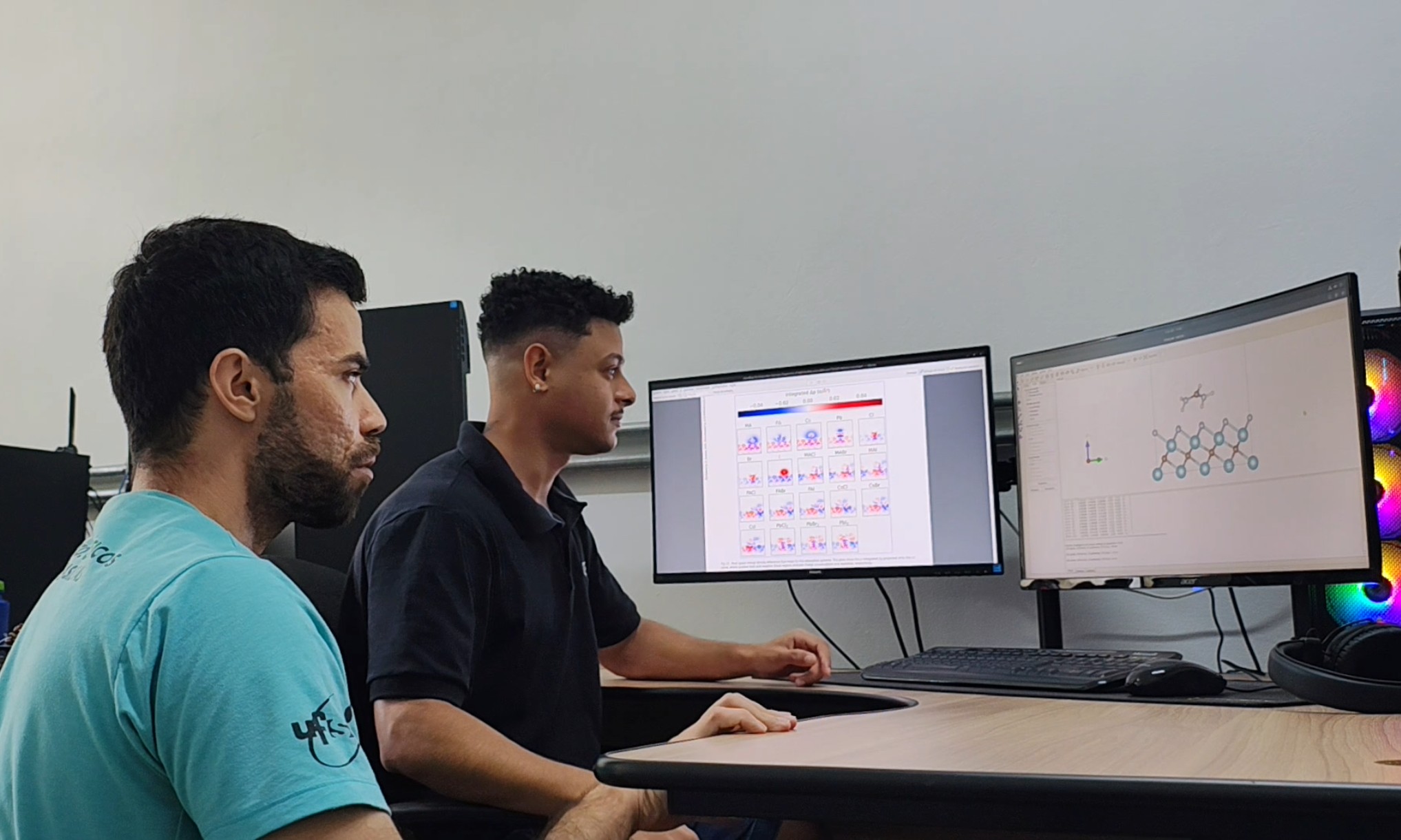
A computational study that revealed the interactions between materials from the perovskite and MXenes families may serve as a guide for designing more efficient and durable solar cells. The work was entirely carried out by a team of researchers from the CINE Computational Materials Science division.
Perovskites are known for their excellent ability to absorb light and convert it into electricity, while MXenes are famous for their very high efficiency in conducting electrical charges. Both materials can be easily processed as thin films – a suitable format for the production of solar cells.
Although they have not yet reached the stage of commercialization, perovskite-based solar cells are very promising, and the use of MXenes in different parts of these devices has already been tested, with good results. However, until the publication of this work, there was no clear understanding of what happens when MXenes and perovskites are in contact.
“Our study used computational simulations based on quantum physics to investigate how two promising materials for the future of solar energy—perovskites and MXenes—interact at the atomic level, that is, how the atoms of one material bind to those of the other,” summarizes Professor Matheus Paes Lima (UFSCar), a CINE researcher who led the work.
According to him, the main result of the study was to show that representative parts of the perovskites (molecular fragments) are extremely strongly attached to the surface of the MXene. “We also observed that this bond is maintained even at relatively high temperatures, above 100 °C, typical of the operation of a solar cell,” adds the scientist.
This strong interaction between the materials would help reduce the degradation that perovskites suffer when in contact with air humidity—a problem that has limited the commercialization of perovskite solar cells. “MXene can act as a stabilizing shield,” explains Professor Matheus.
Furthermore, the authors discovered that the presence of iodine in perovskite promotes the creation of “electrical bridges” at the interface with MXene, allowing electricity to flow more easily between the materials. Therefore, choosing iodine-based perovskites, instead of bromine- or chlorine-based compositions, presents itself as a good choice for composing solar cells.
“When applied in practice, these results can directly impact both the performance and durability of perovskite solar cells,” says Matheus.
The study paves the way for new investigations to advance knowledge and, thus, develop more efficient and stable photovoltaic devices that can be produced on a large scale.
This research was funded by FAPESP, Shell, CAPES, and CNPq, in addition to strategic support from ANP.
Paper reference: Paulo E. Zanni, Jr., Lucas G. Chagas, Rafael L. H. Freire, Juarez L. F. Da Silva, and Matheus P. Lima. Unveiling the interaction between fragments of ABX3 halide perovskite and Ti3C2F2 MXene monolayer. J. Mater. Chem. A, 2026.
CINE members who participated in the work: Paulo E. Zanni Jr (doctoral student at UFSCar), Lucas G. Chagas (doctoral student at UFSCar), Rafael L. H. Freire (postdoctoral researcher at USP), Juarez L. F. Da Silva (professor at IQSC-USP) and Matheus P. Lima (professor at UFSCar).
Contact

Matheus Paes Lima
UFSCar
