




CINE member participates in renewable energy program in China








 E-mail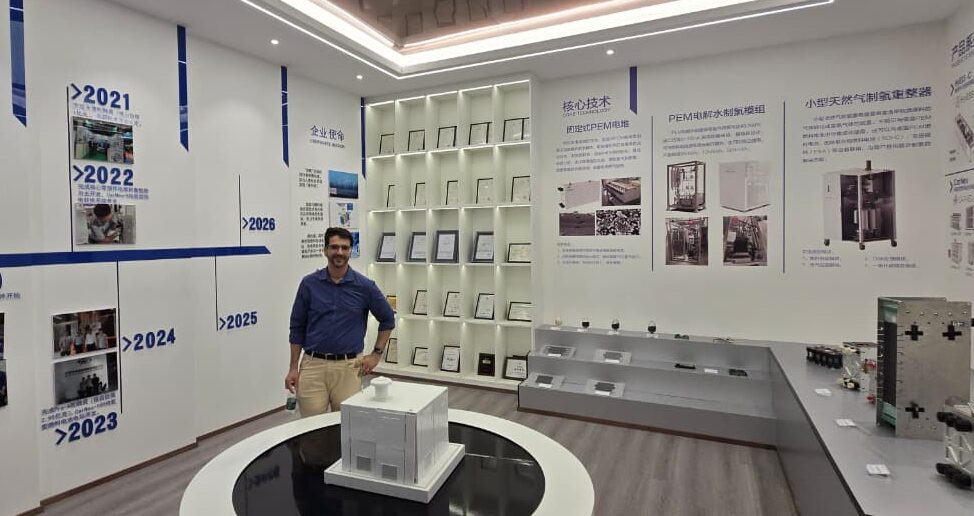
Bruno Bitarães Neto Salgado Brandão, a CINE technology transfer fellow since July 1st of this year, undertook his first work mission in China.
Between July 2 and 22, he participated in academic seminars and visited Chinese companies. Some of these activities took place as part of the “Green Energy Youth Leadership Camp,” an initiative by the North China Electric Power University (NCEPU) designed to immerse young people from around the world in clean energy and sustainable development technologies. This year, the event focused on showcasing solutions developed in China for integrating renewable energy into the power grid.
“The program included seminars on wind energy, solar energy, high-voltage direct current (HVDC) transmission lines, semiconductor devices for AC/DC power conversion, green hydrogen generation and its ecosystem in China, and batteries and BESS,” Bruno details.
During his technical visits, Bruno traveled to seven Chinese cities to tour battery and electrolyzer factories, a State Grid Corporation of China plant combining photovoltaic, wind, and battery technologies, and the headquarters of the state-owned renewable energy company China Three Gorges Corporation.
As a CINE technology transfer fellow, Bruno works at the interface with the industrial sector, identifying research conducted at the center with market potential, seeking out companies interested in these technologies, and encouraging intellectual property protection.
During the mission to China, he had the opportunity to gain insight into how university-industry integration works in the country. “The Chinese development model combines direct investment in fundamental university research with strategic five-year planning at the federal level,” Bruno explains. According to him, based on this strategic direction, each province organizes its own tax incentives and public-private investment schemes. This fosters competition to produce the most efficient and successful companies. “When these companies reach commercial maturity, local incentives are withdrawn, and they are directed toward the international market,” says the CINE fellow.
Bruno holds a degree in Chemistry from UFMG and a PhD in Chemistry from USP. He completed a postdoctoral fellowship at UNICAMP within the scope of CINE, where he helped organize events focused on entrepreneurship training. He has experience managing projects involving high technological risk and advancing technological maturity levels: he served as the lead researcher for an open innovation project between USP and the company Metal-Chek—supported by FAPESP and FINEP—and participated in the creation of the startups Terpenus and Cath Energy.
Contact

Bruno Brandão
UNICAMP
