




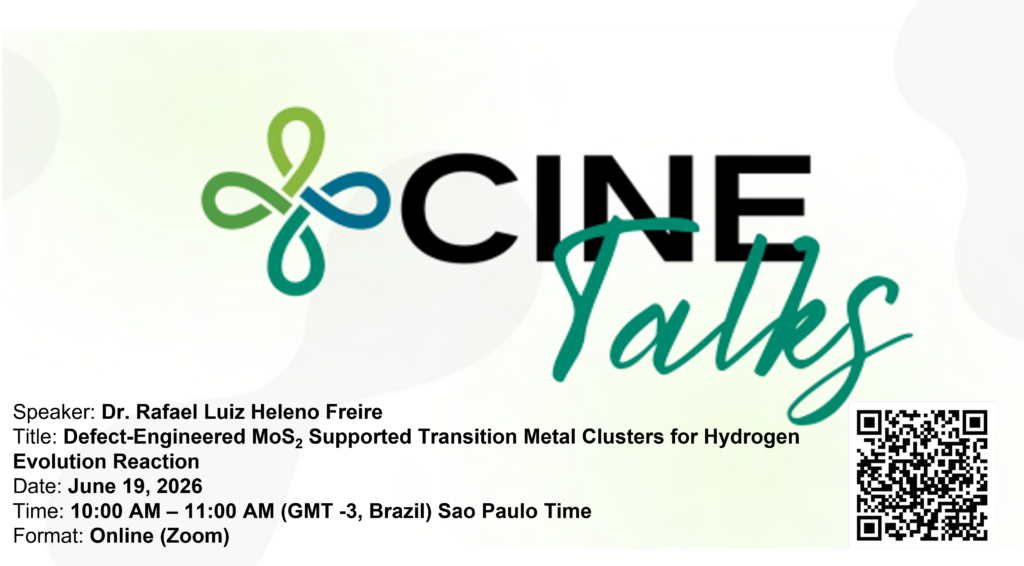
Defect-Engineered MoS₂ Supported Transition Metal Clusters for Hydrogen Evolution Reaction








Abstract
In this seminar, Dr. Rafael will describe a theoretical investigation of transition-metal tetramer clusters (Fe₄, Co₄, Ni₄, and Cu₄) supported on pristine and defect-engineered MoS₂ monolayers for electrocatalytic energy conversion. Using density functional theory calculations combined with the computational hydrogen electrode model, the study explores the stability, structural behavior, and catalytic activity of these systems toward reactions such as the hydrogen evolution reaction (HER), with broader implications for OER and CO₂RR catalyst design. The results demonstrate that sulfur vacancies play a crucial role in stabilizing the metal clusters by acting as anchoring sites, while also modifying their geometric and electronic properties. Distinct behaviors were identified among the different transition metals, including the unusual preference of Ni₄ for pristine regions and the pronounced structural distortion of Cu₄ clusters. Several configurations exhibited near-optimal HER activity, with Fe₄ supported near sulfur vacancies emerging as the most promising catalyst. Overall, the seminar highlights how the interplay between cluster composition and defect engineering can be strategically used to design efficient, non-noble-metal electrocatalysts for sustainable energy applications.
Speaker
Rafael Luiz Heleno Freire holds a Teaching Degree (Licentiate) in Physics (2009) and an M.Sc. in Materials Science and Engineering from the School of Engineering of Ilha Solteira, São Paulo State University (UNESP). His early academic training focused on experimental Materials Science and Condensed Matter Physics, particularly the study of ferroelectric materials within the Ferroelectrics and Novel Materials Research Group. He earned a Ph.D. in Physics from the São Carlos Institute of Physics (IFSC), specializing in Computational Materials Science. His doctoral research employed first-principles methods based on Density Functional Theory (DFT) to investigate the structural, electronic, and energetic properties of metallic surfaces. His research focuses on computational materials science, with an emphasis on first-principles modeling of two-dimensional (2D) materials for hydrogen and sustainable energy technologies. His core expertise centers on density functional theory and high-throughput computational screening. Currently, he focuses on the computational design of 2D materials for hydrogen technologies, actively integrating machine learning approaches to accelerate the discovery and design of advanced catalysts.
Link to registration: https://docs.google.com/forms/d/e/1FAIpQLSf-76vSixnuC48vDZGlw7vdpxMV32NCig6nRad5KtWAQBLufA/viewform?pli=1
Defect-Engineered MoS₂ Supported Transition Metal Clusters for Hydrogen Evolution Reaction
English
Dr. Rafael Luiz Heleno Freire
